
Accessing and Interpreting AI Writing Detection in Canvas (Turnitin)
Guidance for Southern University Faculty and Administrators


1. Purpose of This Document
This document provides:
Clear steps for accessing AI writing detection tools within Canvas
Current best-practice standards for interpreting AI detection analytics
Guardrails for responsible, ethical, and academically defensible use
This guidance applies to all courses using Canvas with Turnitin integration and is especially relevant for graduate and doctoral-level instruction.
2. System Overview
AI writing detection is provided through Turnitin, integrated into Canvas.
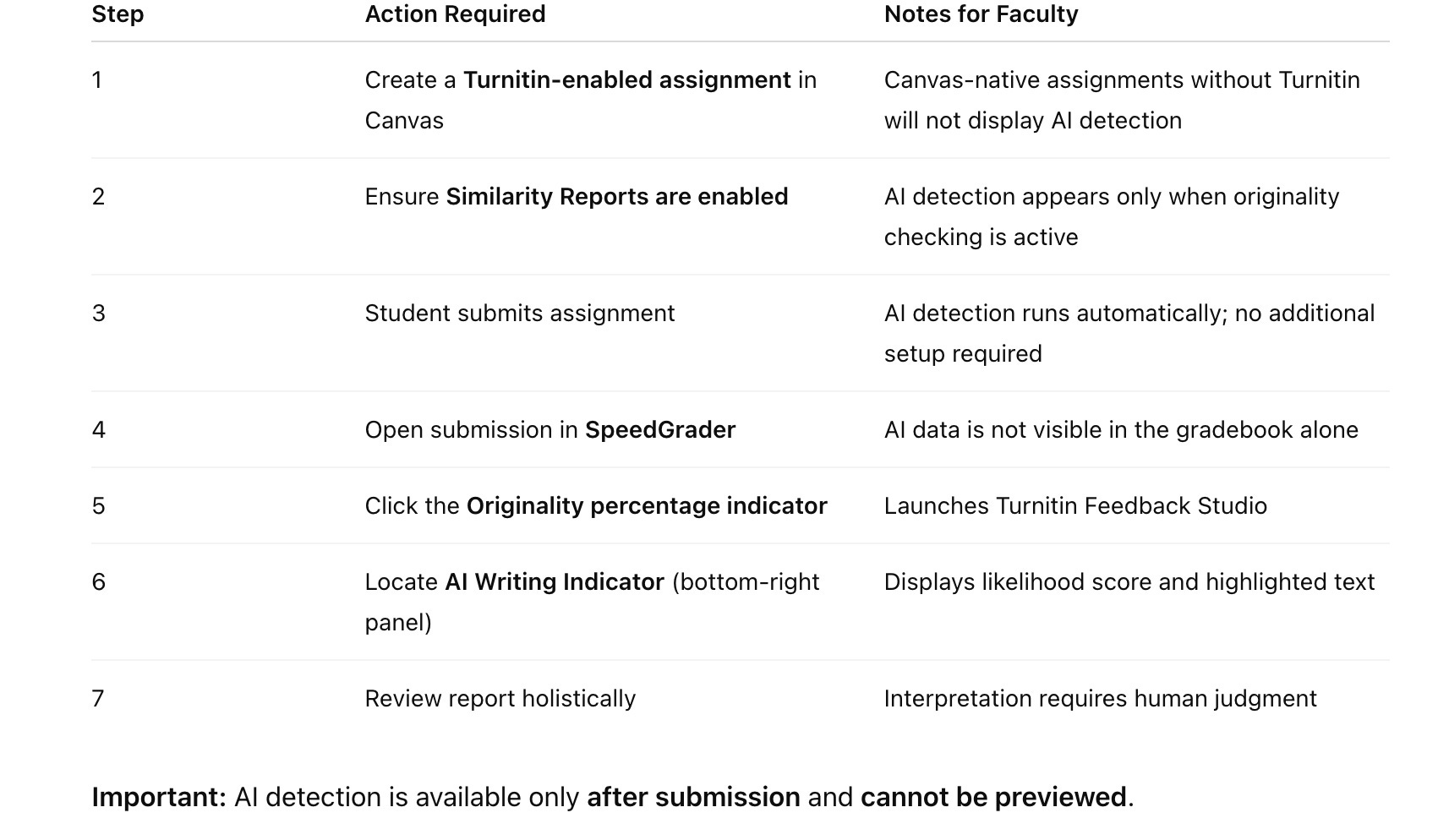
It is not a standalone feature and is accessible only through Turnitin-enabled assignments.
3. Steps to Gain Access to AI Writing Detection
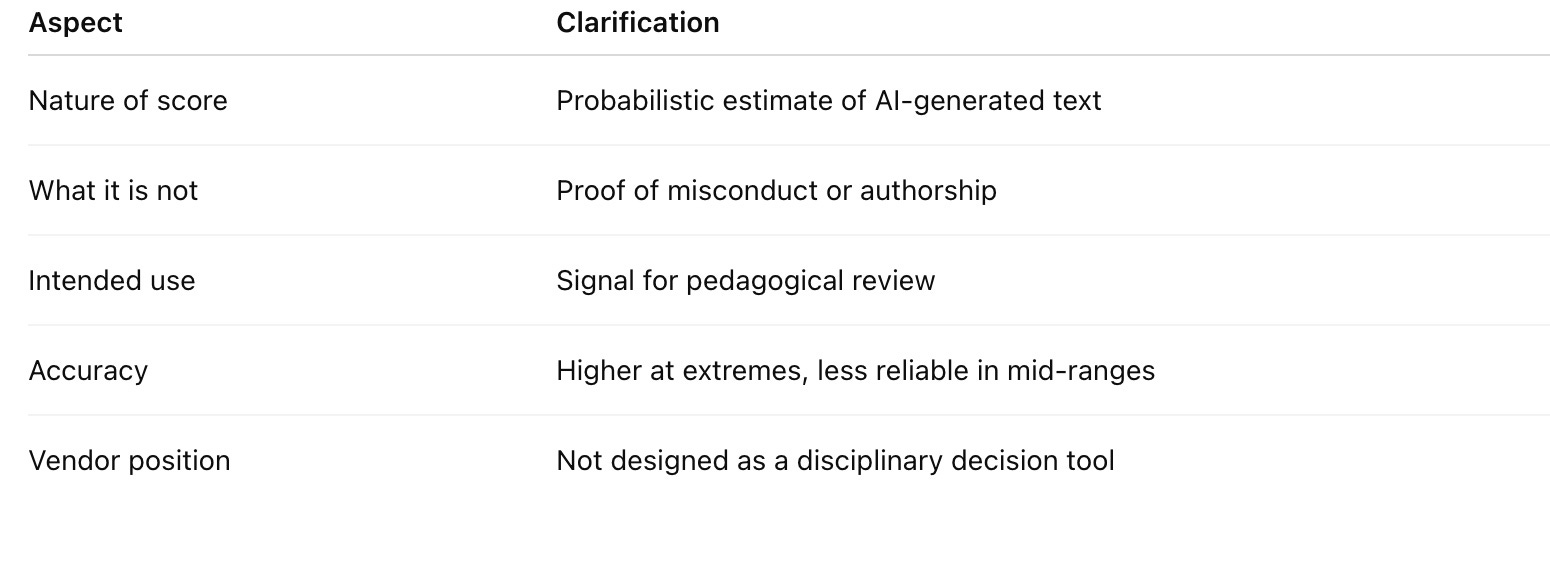
4. What the AI Writing Detection Score Represents
5. Standards for Interpreting AI Detection Analytics
Recommended Interpretation Bands
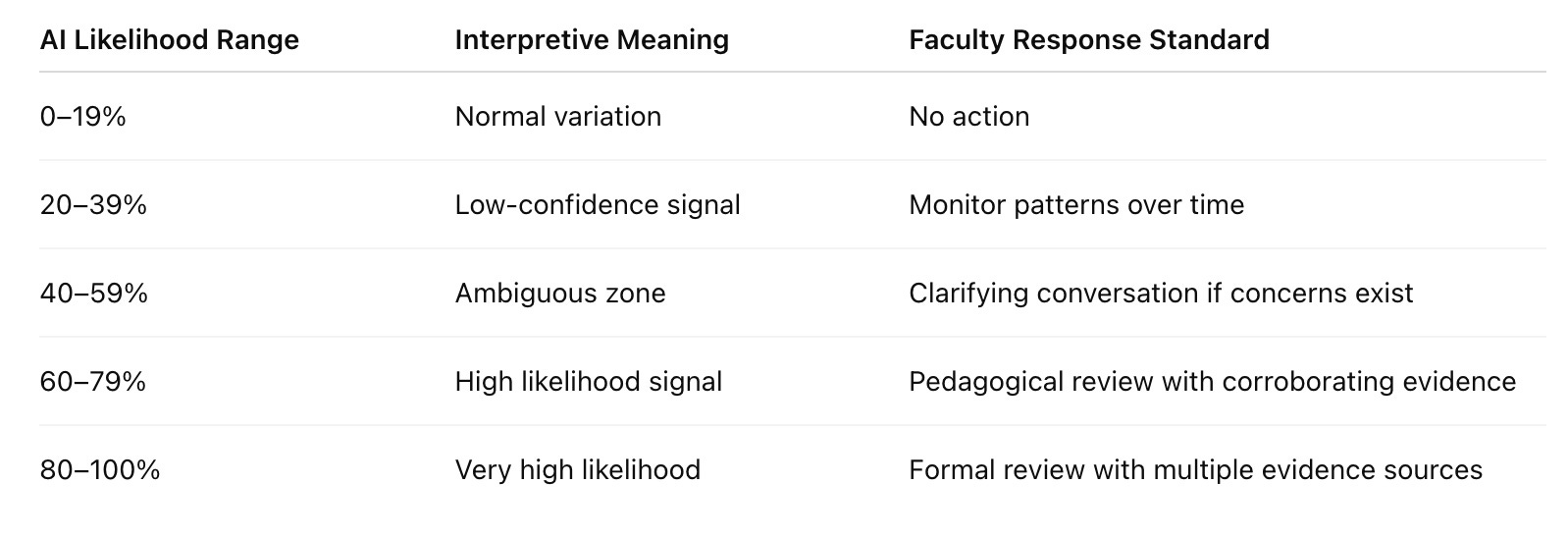
AI scores must never be used in isolation.
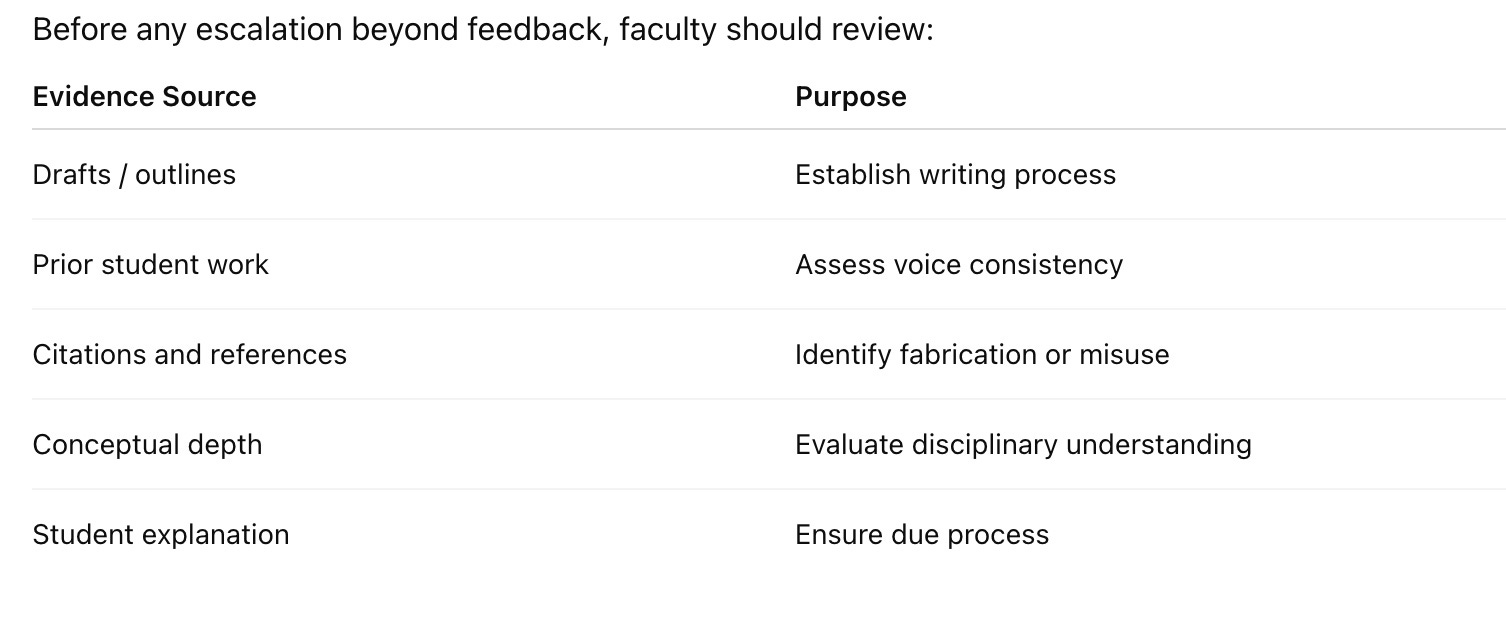
6. Required Corroborating Evidence
Before any escalation beyond feedback, faculty should review:
7. Decision-Making Safeguards
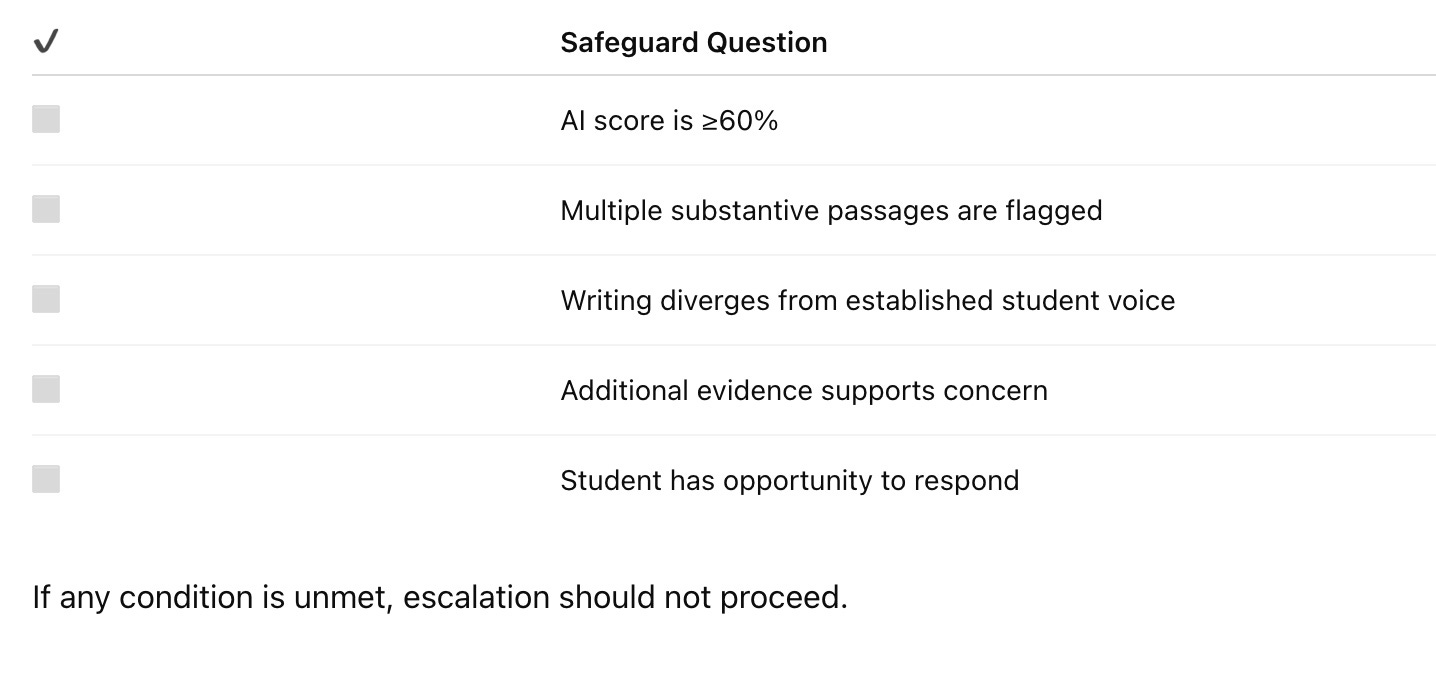
Escalation beyond feedback is appropriate only when all conditions below are met:
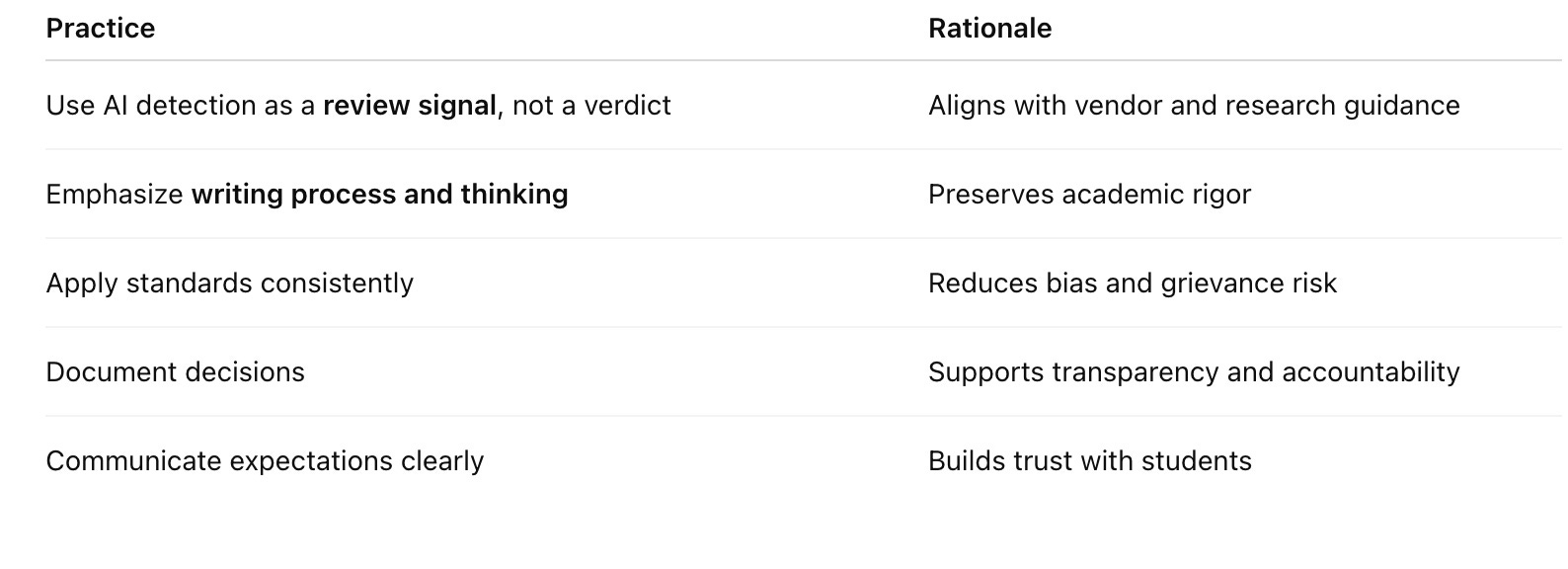
8. Current Best Practices
9. Equity, Ethics, and Academic Integrity
Research shows AI detectors may disproportionately flag:
Multilingual writers
Non-native English speakers
Formulaic academic language
Faculty should interpret reports with awareness of:
Linguistic diversity
Disciplinary writing conventions
Developmental writing stages
10. Authoritative References
Vendor Documentation
Turnitin. AI Writing Detection – Use and Limitations
https://help.turnitin.com/ai-writing-detection.htmTurnitin. Understanding AI Writing Reports
https://help.turnitin.com/feedback-studio/ai-writing.htm
YouTube (Official / Credible)
Turnitin Official: AI Writing Detection Explained
Canvas LMS: Using Turnitin with Canvas
Peer-Reviewed Research
Perkins, M., et al. (2023). AI detectors are unreliable. Computers & Education.
https://doi.org/10.1016/j.compedu.2023.104764Liang, P., et al. (2023). Evaluating the Accuracy of AI Text Detectors. arXiv.
https://arxiv.org/abs/2306.15666
Policy Guidance
UNESCO. (2023). Guidance for Generative AI in Education and Research.
https://www.unesco.org/en/articles/guidance-generative-ai-education-and-researchCouncil of Writing Program Administrators. (2023). Generative AI and Writing.
https://wpacouncil.org/positions/generative-ai
11. Academic Integrity, AI Writing Detection, and Scholarly Judgment
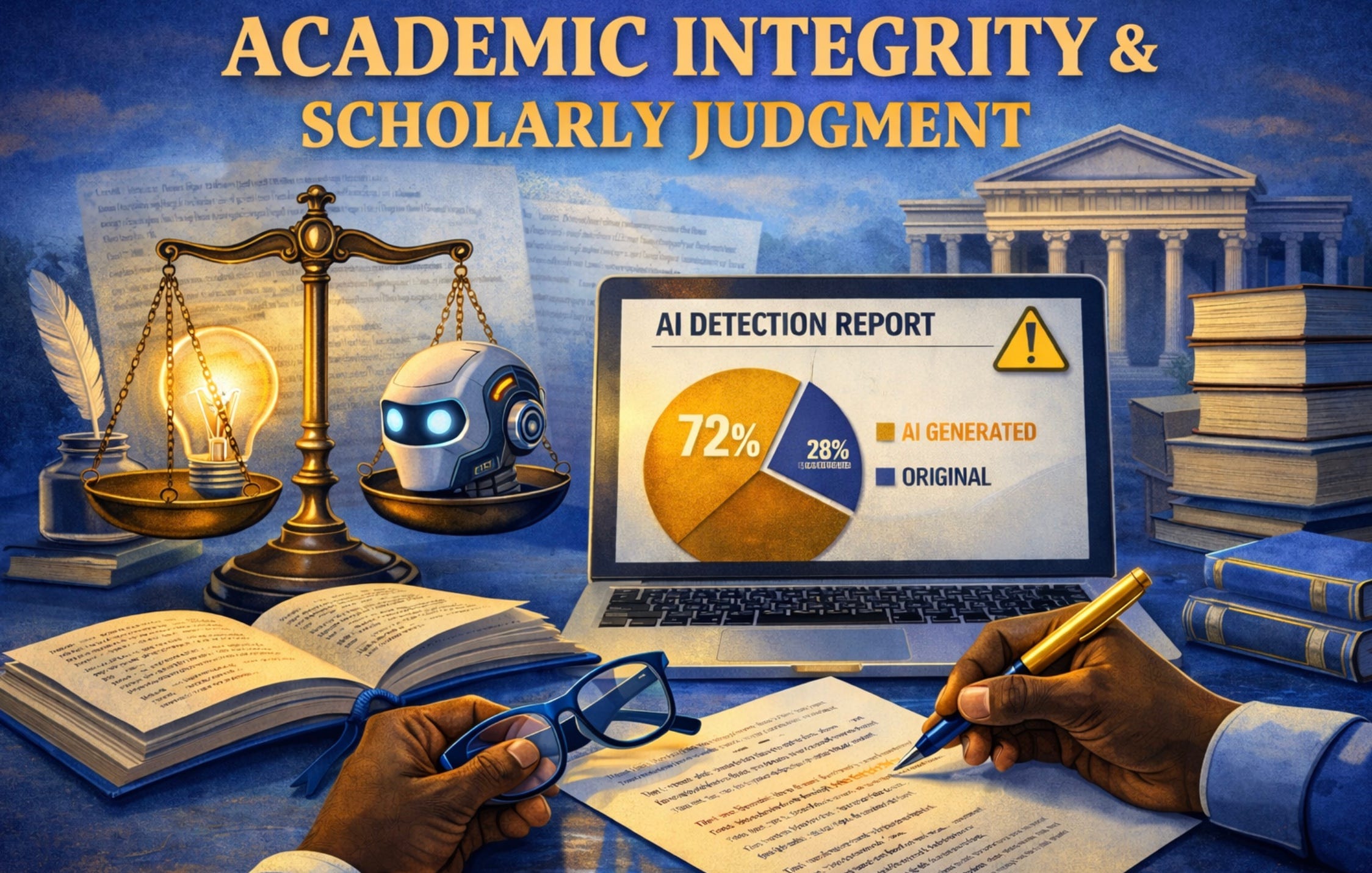
The integration of AI writing detection tools into Canvas—most notably through Turnitin—marks a significant shift in how institutions approach academic integrity. While these tools offer new forms of insight into student writing, they also require careful interpretation, academic judgment, and pedagogical clarity.
At its core, academic integrity is not about technology; it is about authorship, intellectual responsibility, and trust. AI detection tools do not redefine these values—they simply make visible new tensions that already exist between assistance and authorship, process and product, learning and submission.
AI writing indicators in Turnitin are best understood as signals, not verdicts. They highlight patterns that may warrant closer review, but they do not, on their own, determine misconduct. Writing is shaped by many factors—discipline, genre, language background, revision history, and instructional scaffolding—and AI detection scores must always be interpreted within these contexts.
For faculty, the critical task is not to “catch” AI use, but to interpret evidence responsibly and engage students in meaningful conversations about how their work was produced. Detection tools are most effective when paired with:
Clear assignment design
Explicit expectations for authorship
Transparent guidance on acceptable AI use
Opportunities for drafts, reflection, or disclosure
An increasingly recommended practice is the inclusion of an AI-use disclosure statement, in which students indicate whether AI tools were used and how. Disclosure reframes integrity from surveillance to transparency and helps students develop ethical habits as scholars. It also provides faculty with essential context when reviewing Turnitin reports.
Equally important is recognizing what AI detection tools cannot do. They do not assess the quality of reasoning, the depth of synthesis, or the originality of ideas. These remain the domain of academic expertise. Overreliance on detection scores risks shifting integrity from a scholarly judgment to a technical shortcut—an outcome that serves neither students nor institutions.
Academic integrity in the age of AI therefore demands faculty literacy, not just student compliance. Faculty must understand how AI detection tools work, what their limitations are, and how to communicate their use clearly in syllabi and assignments. Institutions, in turn, must support this literacy through professional development and shared governance conversations.
Ultimately, the goal is not to eliminate AI from academic work, but to preserve the meaning of scholarship in its presence. When AI detection is used thoughtfully—embedded within sound pedagogy, transparent expectations, and faculty judgment—it can support integrity without undermining trust.
Academic integrity remains a human responsibility. Technology may assist, but it cannot replace scholarly discernment, disciplinary context, or ethical mentorship.
12. Summary Statement (For Administrative Use)
AI writing detection tools provide probabilistic indicators intended to support pedagogical review.
They must be interpreted through professional judgment, corroborating evidence, and transparent process.
They are not designed to serve as sole evidence of academic misconduct.

Professor Moustapha Diack
Doctoral Program in Science/Math Education (SMED)
College of Science & Engineering (CSE)
Southern University A&M College (SUBR)
Baton Rouge, Louisiana - USA